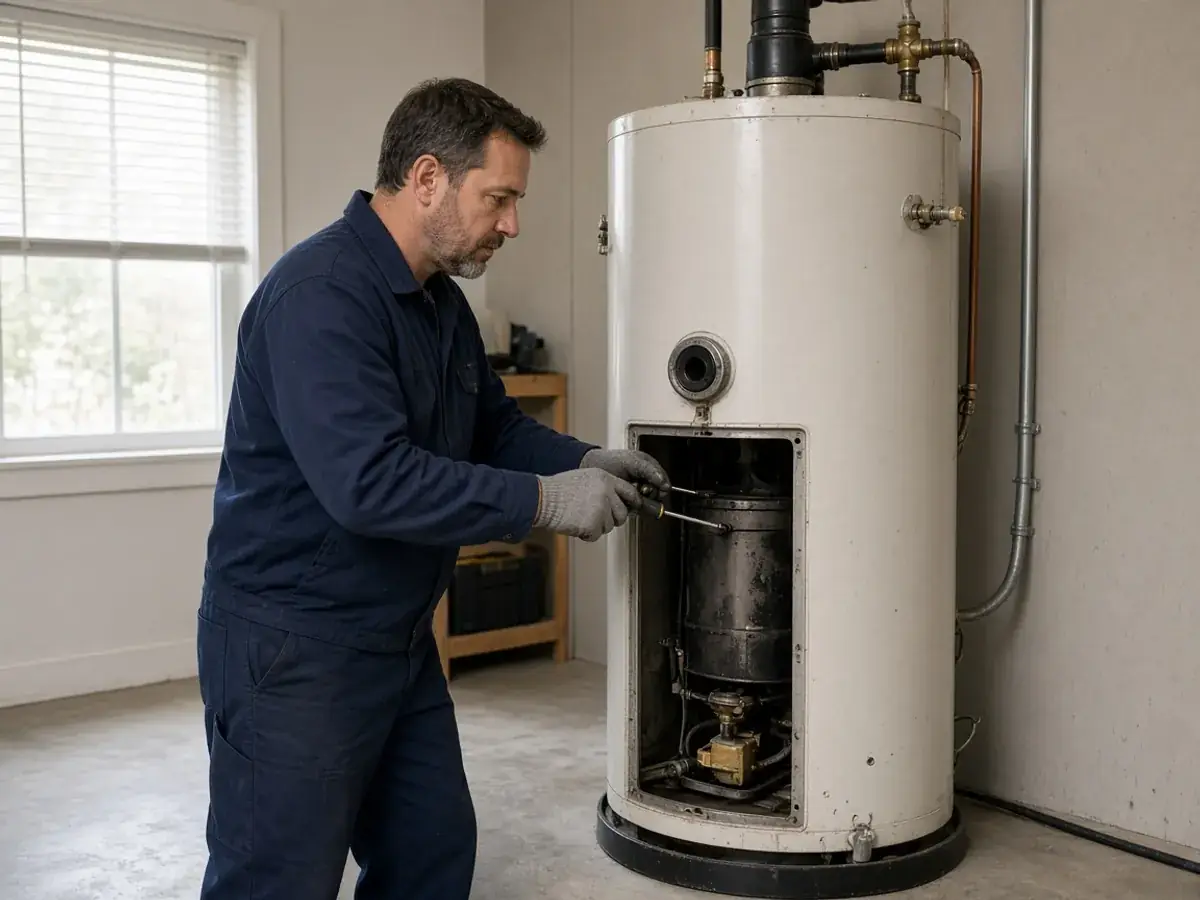
Repair usually makes sense when a water heater is under about 8 to 10 years old and has a single part failure, such as a thermocouple, element or valve. Replace it when the tank leaks, it's older than that and having problems, it needs several repairs, or it can't meet your household's needs.
Decision table
| Situation | Usually | Why |
|---|---|---|
| Tank body leaking | Replace | A tank can't be repaired |
| Under ~8 years, one part failed | Repair | Parts are inexpensive relative to a new unit |
| Over ~10 years, repeated problems | Replace | More failures likely |
| Not enough hot water for household | Replace or upsize | Repair won't add capacity |
| Pilot won't stay lit | Repair first | Thermocouple or valve often fixes it |
| Rumbling from sediment | Flush or repair | Replace if heavy buildup and age |
Published ranges: tank repair about $100 to $500 and replacement about $881 to $1,826 (Angi, updated Oct 16, 2026). See Angi water heater replacement cost.
Lakewood factors
A replacement in Lakewood usually involves a permit and code updates such as seismic straps, required by California Health and Safety Code 19211. Garage and outdoor heaters start with planning review. Factor those into the replacement cost. See water heaters in garages and sheds.
Not sure what you need? Talk it through by phone.
Call (708) 350-9399How to find the age
The manufacture date is usually encoded in the serial number on the label. Many manufacturers publish how to decode it.
Next steps
See water heater repair, water heater replacement, tank vs tankless and the water heater cost guide.
What should you ask on the call?
- Which option fits the condition and layout of my home, and why?
- What extra work would each option need, such as gas line, venting, electrical, drywall or a permit?
- What's the expected lifespan and maintenance for each?
- What warranty comes with the parts and the labor?
- Can I get prices for both options, itemized the same way?
The right answer often depends on things only a site visit can show, like pipe condition, gas line size and available space. A good provider will explain the trade-offs rather than push one option.
What about Lakewood homes affects this choice?
Most Lakewood houses were built between 1950 and 1953, according to the City of Lakewood's history. They're mostly single-story homes on concrete slabs, with the water heater in a garage, closet or outdoor shed, and many still have some original galvanized supply pipe and early sewer laterals. That shapes the options: attic routing makes repipes simpler, garage heaters raise placement and permit questions, older gas lines may need upsizing for tankless units, and old laterals may not suit aggressive cleaning. The Lakewood Building and Safety permits page lists which projects often need a permit.
How was this guide researched?
This guide was written for Lakewood, California homeowners and checked against the sources below on November 11, 2026. Rules and prices change, so confirm anything important with the agency or provider. See our editorial policy.